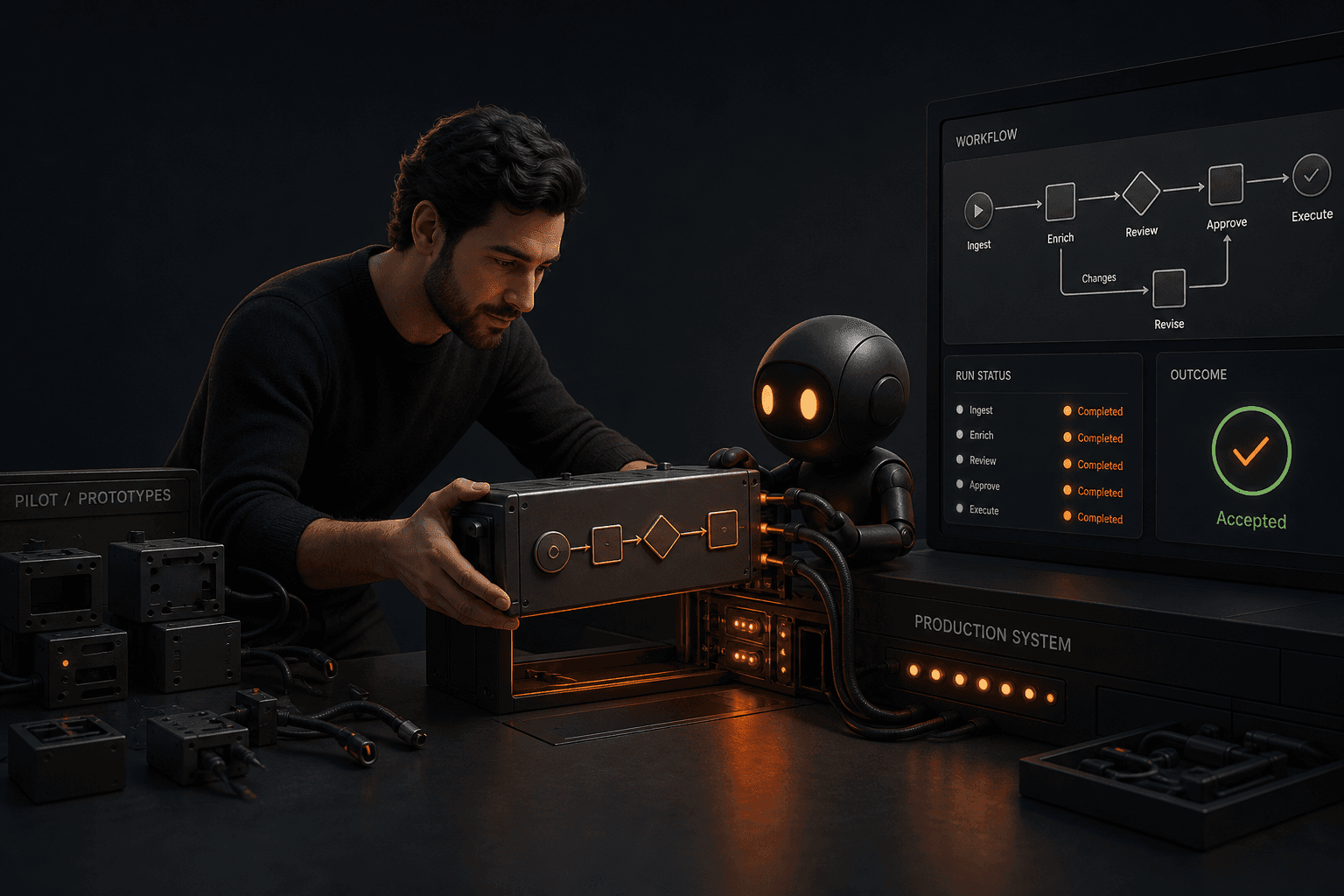
Most companies do not fail at AI because they chose the wrong model. They fail because a promising pilot never becomes a reliable part of how the business runs.
That gap—between demo and production—is now attracting serious capital. This week, Anthropic and Blackstone put a name and a valuation on it. For founders and SME leaders, the message is clear: access to intelligence is getting easier. Turning that intelligence into durable business outcomes is still hard work.
Executive summary
What leaders need to know
- Anthropic, Blackstone, Hellman & Friedman, and other investors launched Ode, a roughly $1.5 billion AI implementation firm built to put models into real business systems.
- OpenAI has a similar bet with The Deployment Company. Frontier labs now treat implementation as a category, not an afterthought.
- Most AI value is created after model selection—in workflows, data, approvals, integrations, and product design.
- Pilots stall when companies buy tools without redesigning the process those tools are supposed to improve.
- Founders should stop chasing model novelty and start funding production systems with clear owners, metrics, and fallback plans.
What happened?
According to TechCrunch, Ode with Anthropic is the $1.5 billion AI implementation company Anthropic launched with Blackstone, Hellman & Friedman, Goldman Sachs, and others. The firm grew out of Fractional AI, an applied engineering boutique Blackstone noticed while trying to wire AI into portfolio companies.
Ode sends experienced engineers into customer environments, identifies where AI can change operations, and builds the systems that do it. It currently employs about 100 engineers. The company says it will work "Claude-first," but will use other models when needed.
The larger signal matters more than the brand name. OpenAI has already created The Deployment Company for a similar reason. Large consultancies are building forward-deployed teams of their own. Eddie Siegel, Ode's CTO, told TechCrunch that model selection matters, but it is not where most of the work happens. He compared it to choosing a programming language: important, yet not the definition of the transformation.
Why should a business owner care?
If you run a startup, SME, or product team, this news is not about joining a private-equity portfolio. It is about a market diagnosis that applies to companies of every size:
- Buying AI access is no longer a strategy.
- Demos are cheap. Production systems are expensive—and valuable.
- The scarce resource is applied product engineering, not another chat interface.
Many leaders still measure AI progress by licenses purchased, features launched, or models tested. Those metrics can look healthy while the business sees no change in cycle time, error rates, margin, or revenue capacity.
Ode's existence is a reminder that even well-funded enterprises struggle to move from experiment to operating system. If Blackstone and Anthropic believe implementation is a trillion-dollar category, founders should treat process redesign and product engineering as first-class investments—not side projects for whoever has spare time.
Why AI pilots stall
A pilot usually proves that a model can draft, classify, summarize, or answer questions in a controlled setting. Production requires something harder:
- Clean inputs from the tools your team already uses.
- Clear definitions of an acceptable result.
- Human review where risk is high.
- Logging, permissions, and audit trails.
- Ownership when the output is wrong.
- Integration into the workflow people open every morning.
Without those pieces, the pilot dies quietly. Teams keep the subscription. Leaders keep the slide deck. The process stays manual.
A practical distinction
A pilot answers, "Can the model do this?" A production system answers, "Can the business rely on this every day, under real constraints, with measurable outcomes?"
Opportunities this creates
For founders and SME leaders, the implementation wave creates a useful opening.
Win on process, not novelty. Competitors can buy the same models you buy. They cannot quickly copy your customer handoffs, pricing rules, fulfillment logic, or support playbooks once those are encoded into software.
Fund fewer, deeper workflows. One production system that reduces quote turnaround, claim rework, or onboarding delay is worth more than five disconnected demos.
Build product leverage. Custom software and SaaS features that wrap AI in your domain workflow create sticky value. The model becomes an ingredient. The product becomes the asset.
Hire for shipping, not prompting alone. The teams that succeed look like product engineers: people who can own a problem end to end, connect systems, define outcomes, and revise until the business result holds.
Risks to manage now
Ignoring the implementation gap creates expensive patterns:
- Tool sprawl: many AI subscriptions, little operational change.
- Shadow workflows: staff paste sensitive data into chat tools with no controls.
- False confidence: a strong demo becomes a roadmap commitment before quality, cost, and ownership are defined.
- Vendor capture: business logic ends up inside one assistant instead of your own product layer.
- Pilot fatigue: teams stop believing AI projects because earlier ones never shipped.
The risk is not that models will stop improving. The risk is that your organization spends another year collecting experiments while competitors turn one workflow into a durable advantage.
What founders should do next
- Pick one painful, repeatable workflow. Prefer work with clear inputs, clear outputs, and measurable delay or error cost—support triage, lead qualification, invoice checks, onboarding, or internal reporting.
- Define "accepted" before you build. Write the quality bar, escalation path, and success metric. If you cannot define success, you are not ready to automate.
- Design the system, not the chat box. Map data sources, permissions, human review, logging, and where the result lands in the customer or employee journey.
- Measure cost per accepted outcome. Include model usage, retries, review time, tool fees, and rework. Compare that with time saved and capacity created.
- Keep models replaceable. Own prompts, business rules, evaluations, and product logic in your application so a provider change does not force a rewrite.
- Assign an owner. Every production AI workflow needs a named product or operations owner responsible for quality, cost, and iteration.
You do not need a $1.5 billion joint venture to do this. You need the same mindset: treat AI as a component inside a product and process redesign, not as a magic layer dropped on top of unchanged work.
Ship the system, not the slide deck
Anthropic and Blackstone's bet on Ode is a public admission of something operators already feel: models alone do not transform a company. Systems do. The founders who benefit will be the ones who move one workflow from pilot to production, measure the outcome, and keep improving it.
ReplikaTech helps businesses design SaaS platforms, custom software, mobile products, and AI-powered workflows that leave the demo stage and become reliable parts of how revenue, operations, and customer experience actually work.