Most founders treat AI vendors like utilities. Pick a model, connect an API, ship features, and move on. That works until the vendor changes pricing, replaces the model inside your stack, or starts selling a competing end-to-end product to the same customers.
This week's reporting on Microsoft's sales strategy is a clear signal that the AI market is entering that phase. The winners will not be the companies with the most model subscriptions. They will be the ones whose products can still create value when vendors compete, consolidate, or raise prices.
Executive summary
What leaders need to know
- Microsoft is coaching sellers to position its own AI stack against OpenAI and Anthropic on cost, security, and platform completeness.
- Vendor competition is good for buyers—but only if you can switch, compare, and route work without rebuilding your product.
- Lock-in risk grows when prompts, workflows, data pipelines, and evaluations are tied to one provider's quirks.
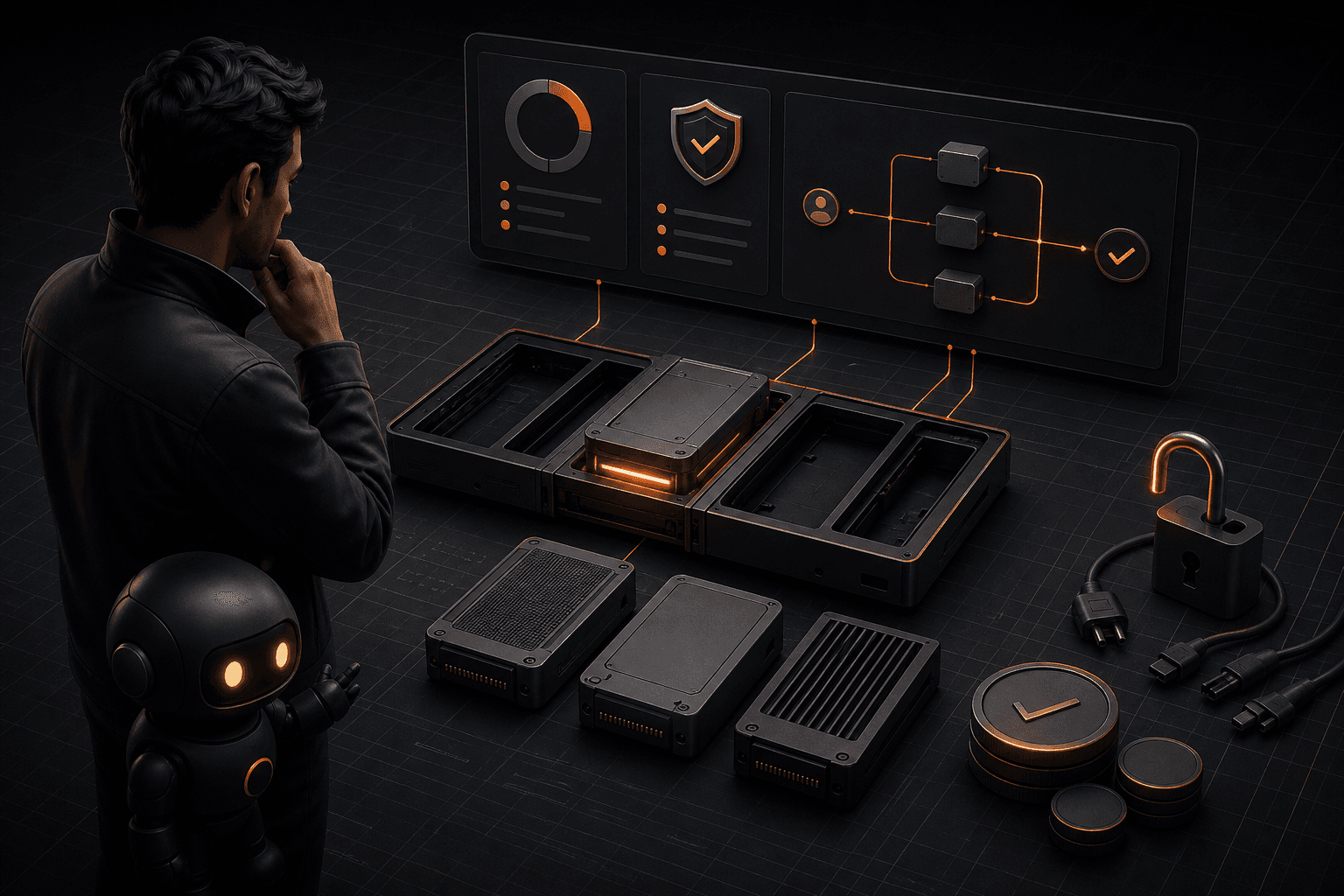
- The practical response is a modular AI layer: clear interfaces, outcome metrics, fallback models, and ownership of your business logic.
- Founders should treat models as replaceable engines and treat product workflows as the durable asset.
What happened?
According to TechCrunch's coverage of Bloomberg reporting, Microsoft executives used a fiscal-year strategy session to arm sales teams with competitive arguments against OpenAI, Anthropic, and Google. The pitch emphasizes Microsoft's own models as more cost-effective and better integrated into an end-to-end system.
One executive framed the message bluntly: everyone else is selling parts, while Microsoft is selling the full system. Another presentation reportedly compared Copilot directly with Anthropic's Claude inside Office apps, arguing Claude was slower, less accurate, and weaker on security integrations in that context.
The timing matters. Microsoft has already been reported to replace some third-party models in products like Excel and Outlook with cheaper in-house alternatives. Partnerships that once looked permanent are now clearly commercial relationships. That is normal in mature markets. It is also a warning for any company whose product depends on one vendor remaining friendly, stable, and cheap.
Why should a business owner care?
If you are building a SaaS product, internal automation, or customer-facing workflow on top of a single AI provider, three things can change overnight:
- Price:Model costs fall—or climb—based on the vendor's margin pressure, not your roadmap.
- Access: Features, rate limits, data policies, or regional availability can shift without warning.
- Competition: Your vendor can package the same capability into a product that sells directly to your buyers.
Microsoft's sales push is not uniquely aggressive. It is an early look at how large platforms will fight for AI budgets: cost control, security, and “one stack for everything.” For founders and SMEs, the business question is whether your product can survive that fight—or whether a pricing change or product decision from one company can stall your roadmap.
This is not an argument against using Microsoft, OpenAI, Anthropic, Google, or anyone else. It is an argument against treating any of them as infrastructure you cannot redesign around.
The real lock-in is not the API key
Many teams think they are flexible because they can point an environment variable at a different model. That is rarely enough. Real lock-in lives deeper:
- Prompts tuned to one model's style, tool format, or refusal behavior.
- Evaluation suites that only measure quality on one provider.
- Embeddings, memory stores, and retrieval pipelines that are hard to reindex or remigrate.
- Business rules buried inside vendor-specific assistants instead of your own application layer.
- Contracts, data residency assumptions, and security reviews that assume one supplier forever.
If switching models means rewriting workflows, retraining staff, and restarting compliance, you do not have a flexible AI stack. You have a soft dependency dressed up as modern architecture.
A simple test
Ask your team: “If our primary model became 2x more expensive or 20% worse tomorrow, how long would it take to move critical workflows?” If the answer is measured in months, vendor risk is already a product risk.
Opportunities this creates
Vendor competition can help buyers—if you are ready to take advantage of it.
Negotiate from evidence. When platforms compete on cost and security, companies with usage data, quality benchmarks, and alternative options get better terms. Companies with no fallback usually accept the first proposal.
Route work by outcome. Routine extraction, classification, and drafting can run on cheaper models. Complex analysis, customer-facing writing, or high-risk decisions can use stronger models with human review. The goal is lower cost per accepted result, not loyalty to a brand.
Own the workflow layer. The durable advantage is not access to a popular model. It is your process knowledge, approval rules, proprietary data, and product experience. Custom software turns a common model into a capability competitors cannot buy with the same subscription.
Sell trust, not novelty. As vendors clash over security and platform completeness, customers will ask harder questions about audit logs, data handling, fallback plans, and vendor concentration. Products that answer those questions clearly will win deals that flashy demos lose.
Risks to manage now
Ignoring this shift creates quiet but expensive problems:
- Margin compression if model prices rise and your product cannot switch or degrade gracefully.
- Delivery delays if a provider changes tool formats, latency, or content policies mid-quarter.
- Security and compliance gaps if you inherit a vendor's assumptions instead of defining your own controls.
- Strategic surprise if your platform partner ships a competing feature into the suite your customers already use.
The risk is not that Microsoft, OpenAI, or Anthropic will disappear tomorrow. The risk is that your roadmap becomes reactive to their sales and product cycles.
What founders should do next
- Inventory critical AI dependencies. List every workflow that would break if one model, embedding store, or assistant product became unavailable.
- Separate engines from products. Keep prompts, tools, business rules, and UI in your application. Treat models as swappable components behind a clear interface.
- Define accepted outcomes. Measure cost and quality per resolved case, approved document, qualified lead, or completed order—not per token brand.
- Maintain at least one evaluated fallback. Test a second provider on real work before you need it. Document when routing should switch automatically.
- Review contracts and data paths. Know where customer data goes, what happens on termination, and how fast you can export or reprocess it.
- Invest in the layer vendors cannot sell you.Your domain workflows, integrations, and customer experience are the product. Models are inputs.
For early-stage teams, this does not mean building a complex multi-cloud AI platform on day one. It means designing so that a second model is a configuration and evaluation exercise—not a rewrite.
Build products that outlast vendor seasons
Microsoft's latest sales playbook is a reminder that AI partnerships are commercial relationships under pressure. Cost, security, and platform control will keep shifting. Founders who treat one vendor as strategy will keep reacting. Founders who treat models as replaceable engines—and workflows as the real product—will keep shipping.
ReplikaTech helps businesses design SaaS platforms, custom software, AI-powered workflows, and mobile products with modular architecture, measurable outcomes, and room to change providers without rewriting the business.