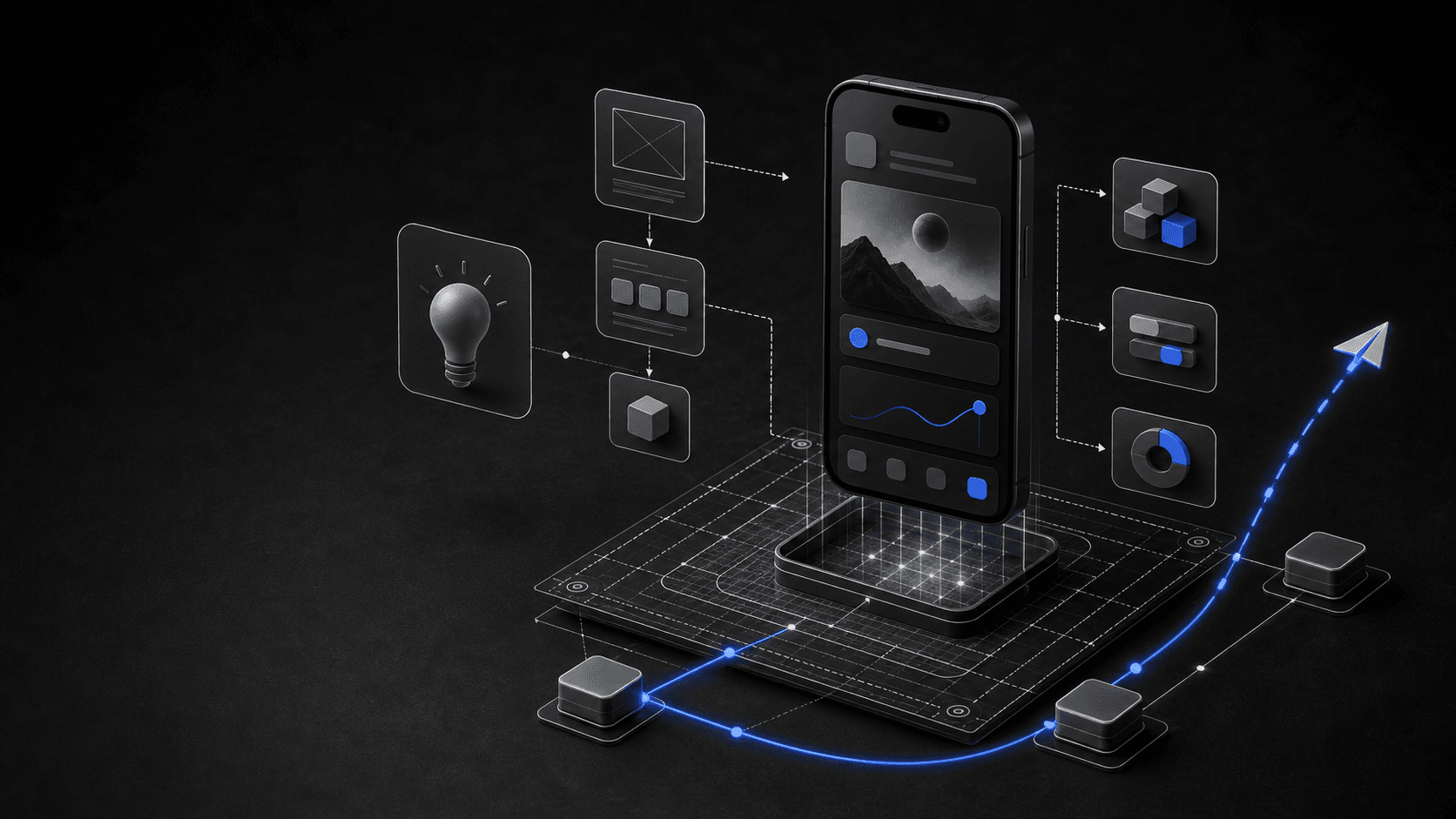
Most founders do not struggle because they lack ideas. They struggle because an idea quickly becomes a long feature list: login, payments, notifications, dashboards, chat, loyalty, AI, and more. Building all of it before speaking to users is expensive—and often unnecessary.
An MVP, or minimum viable product, gives you a better route. It is a real, usable mobile app that proves the core value of your product with the least avoidable complexity. Here is how to build one with confidence.
Start with a specific problem, not an app idea
“I want to build a fitness app” is an idea. “Busy professionals need a fast way to find and book nearby sports venues” is a problem worth testing. The more clearly you define the user, their moment of frustration, and the desired outcome, the easier it is to make smart product decisions.
Write down simple answers to these questions:
- Who will use this first?
- What do they do today instead?
- What makes their current process slow, costly, or frustrating?
- What single result should they get from your app?
Validate the problem before you build
Validation is not asking friends whether they like your concept. Speak with potential users, observe their current workflow, and ask what they have already tried. Look for repeated pain, not polite encouragement.
You can validate early with interviews, a landing page, a clickable prototype, or a manual concierge version of the service. If people will not give you their time, contact details, or a small commitment before the app exists, more features will not solve the underlying problem.
Define one core user journey
Your MVP should have one clear promise. For a venue-booking app, that may be: discover a venue, choose a slot, and make a booking. For an e-commerce app, it may be: find a product and place an order. Everything else should support that journey or wait.
A useful scope test
Ask: “If we removed this feature, could the user still achieve the main outcome?” If the answer is yes, it belongs in the backlog—not version one.
Turn the journey into a focused feature list
Separate features into three lists: must have, should have later, and not now. Your must-have list usually includes a simple onboarding flow, the core action, essential data, and a way for the business to manage the operation. It does not need every social, automation, or personalisation feature on day one.
This is where experienced product and engineering input matters. A good team helps you identify where a trusted third-party service is enough—such as payments, authentication, analytics, or maps—so you do not spend time rebuilding standard infrastructure.
Prototype the experience before development
A prototype makes your product tangible before code makes it expensive. Map the screens, key decisions, error states, and the smallest number of taps required to reach the desired outcome. Test this flow with potential users. Watch where they hesitate and ask what they expected to happen next.
Good UX is not decoration. It removes uncertainty, reduces support needs, and makes the app feel trustworthy from the first use.
Choose the technology around the product
The right stack is the one that supports your priorities: launch speed, platform requirements, performance, integrations, and long-term maintenance. Cross-platform development can be a smart route for many business apps because it allows iOS and Android delivery from a shared codebase. Native development may be the better choice when platform-specific capabilities, complex graphics, or exceptionally demanding performance are central to the product.
Avoid choosing a framework because it is fashionable. Choose it because it fits the product you need to validate now and the team that will maintain it later.
Build, test, and prepare for launch
Development should happen in small, visible milestones. Review the app regularly against the approved user journey, test on real devices, and confirm that key actions work under normal conditions. Do not leave security, performance, analytics, and store submission preparation until the last week.
Before launch, define the few signals that tell you whether the MVP is working. Depending on your product, these could be completed bookings, first orders, active users, repeat usage, or qualified leads. Metrics turn feedback into direction.
Launch to learn, then improve deliberately
Launching an MVP is the beginning of product discovery, not the finish line. Talk to early users, review behavioural data, and prioritise improvements based on evidence. The goal is not to ship every request. It is to strengthen the core experience that users value most.
Starting small gives you room to learn without wasting months on features nobody needs. Once the value is proven, you can scale the product with clarity.
Ready to turn your app idea into an MVP?
ReplikaTech helps founders define the right first version, design intuitive user journeys, and build scalable mobile products for iOS and Android. We focus on the business outcome behind every feature—not just the feature itself.